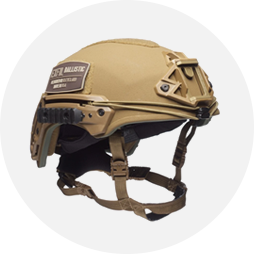
 Utilizing the latest technology in ballistic materials, the SOH High Ballistic Helmet was designed to exceed the expectations of the MICH helmet by providing maximum Level 3A protection (44 Mag. 240 gr. at 1400 FPS) and optimizing comfort and function for long periods of operation. The SOH-2006 provides the following advantages:
Features:
- Superior ballistic, fragmentation, and impact protection, with reduced head borne weight
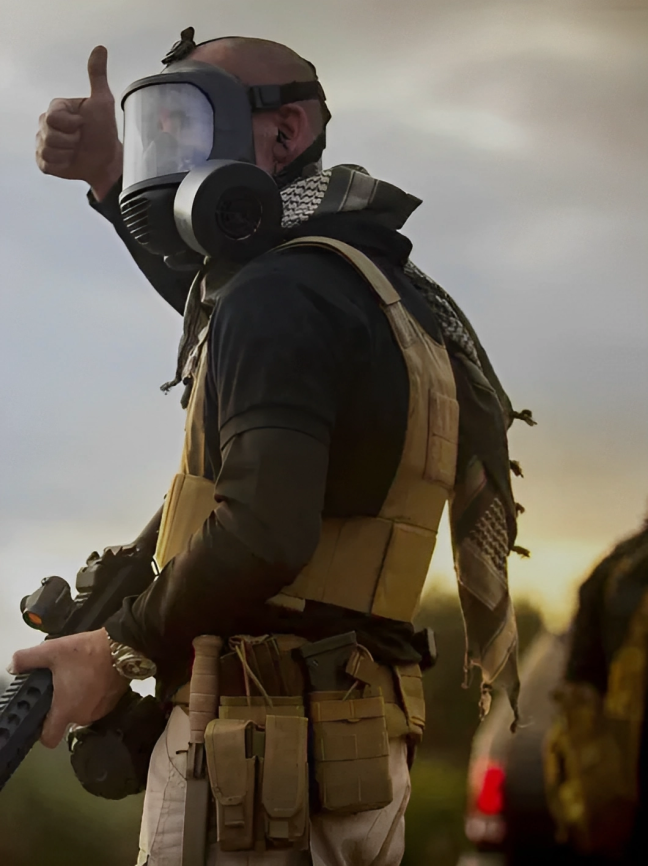
- Improved compatibility with night vision, communication, Nuclear, Biological, and Chemical equipment.
- Performs in all environmental conditions from -40F to -160F
- Reduce profile optimizes peripheral vision and sensory awareness, not leaving the operator disadvantaged in hostile environments.
- Improved interface with body armor, allowing the user to have a full range of motion, even in the prone position.
- A 4 point, fully adjustable strap-harness suspension system maximizes stability and comfort.
- The Pad Suspension system includes 7 highly engineered removable pads, which dramatically increase the operators comfort level.
Pad Suspension System:
- 7 highly engineered pads (1 crown and six oval and trapezoid pads)
- Pad are removable ( hand washable-mild detergent)
- Pads mold and conform to the shape of the operator’s head
- Pads can be moved around to accommodate gas masks, communication equipment etc..)
- Minimizes shock loads from ballistic, fragmentation, and blunt trauma, thus dramatically reducing risk of non-ballistic injury.
- Pads provide increased air circulation in the helmet, keeping the operator cooler, and less likely to experience heat trauma.
- Provides a quieter environment for the operator
- Minimizes pressure points
Today, this new lightweight military helmet already fielded to U.S. special operations forces and elite Army infantry units could, in the future, be distributed among conventional troops.
The helmet itself was tested by the Army Test and Evaluation Command (ATEC) at Aberdeen Proving Grounds, Md., and by the Airborne Special Operations Test Directorate (ABSOTD) at Fort Bragg, N.C.
'The helmet fielded fully to all of the United States Special Operations Command. This consists of the Rangers, Special Forces, Navy SEALs and Air Force Special Operations.
This helmet is also fully fielded to the Marine Corps reconnaissance community, the FBI’s Hostage Response Team, and the 82nd Airborne Division,' said Richard Elder, project officer for the MICH.
This helmet has numerous advantages over the traditional combat headgear.
Firstly, the out standing point is the higher cut of this helmet which allows a user to have complete range of motion while using the complete range of load carriage systems and body armor employed by our user groups. Because it allows a user to lay in the prone and engage a target.
This task was very difficult to impossible with the old PASGT (Personnel Armor System Ground Troops) helmet while wearing most body armor and load carriage.
Secondly, The TC 2000 helmet has a six-, seven-, or eight-pad foam suspension system. The pads can be added, removed or changed, based on the soldier’s comfort level. Pads in the crown portion of the helmet can be replaced by oblong or oval pads. The pad suspension is universally tailorable to the users’ head shape while affording greatly increased impact protection.
After being worn for several minutes, the pads loosen up and eventually conform to the shape of the soldier’s head. Moreover, the helmet only comes in two sizes, while past helmets have come in five sizes. This is because the pads are adjustable and can be molded more accurately to the head.
The helmet also protects from flying bullets. The ballistics are rated to stop a 9 mm bullet traveling 1,450 feet per second, from 0 degrees of obliquity (straight on, with no angle) with a high degree of survivability.
Users have been shot in the head and survived with the ability to fight on. In addition, the suspension system has special components that add to the helmet’s durability.
At last but not the least, the TC 2000 helmet was developed to be equipped on some radio communication systems. The communications piece was developed by modifying commercial off-the-shelf technology, with different versions developed for both land and maritime operations. The helmet is compatible with approximately 30 communications platforms specific to the special operations community. It is also approved to be jumped during an AIRBORNE OPERATION.
|